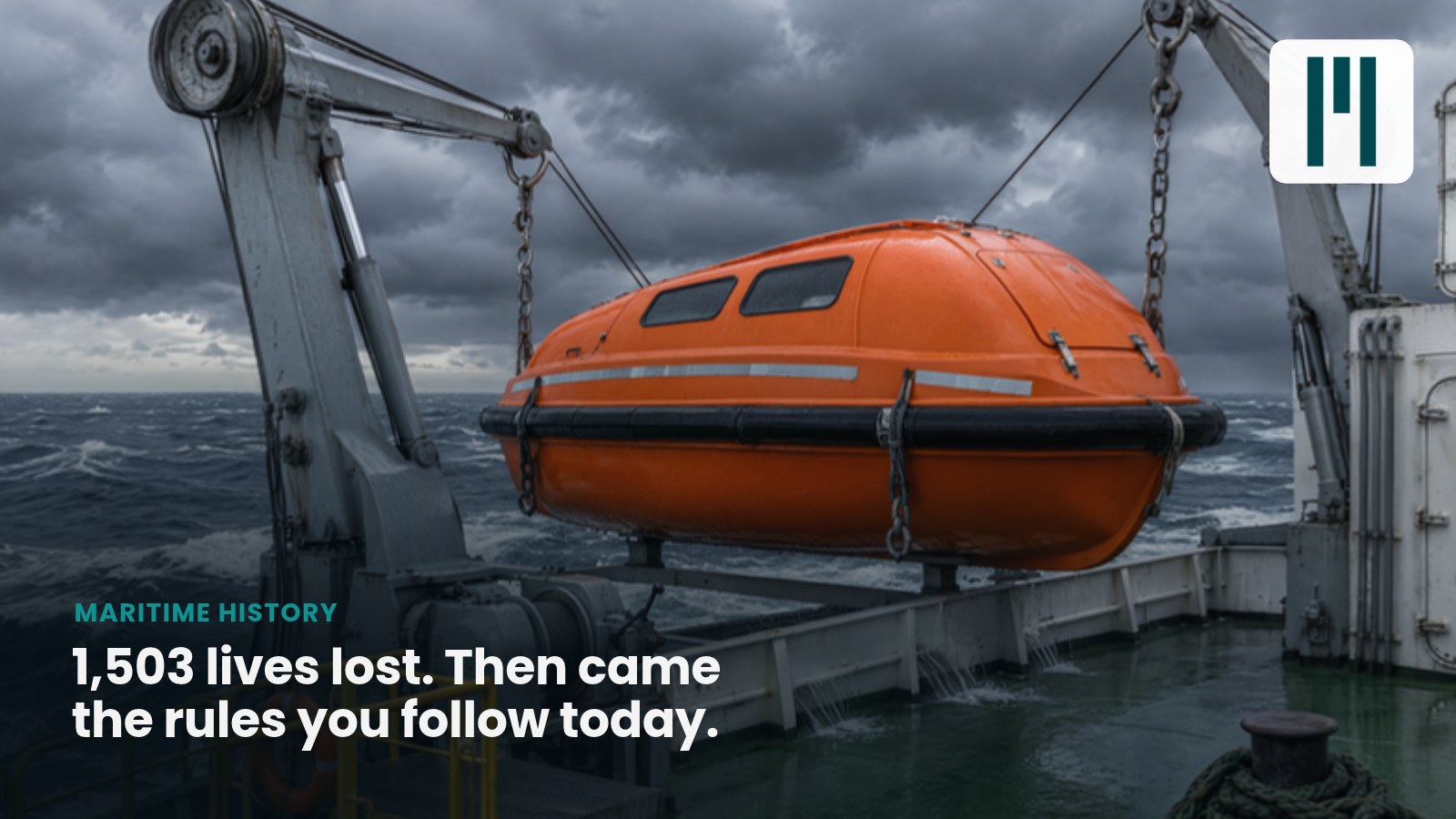
Look around any ship and you will see history.
The lifeboats on the boat deck. The oily water separator in the engine room. The Safety Management System manuals on the bridge.
Each of them exists because something once went badly wrong.
In April 1912, the Titanic sank on her maiden voyage, and 1,503 people lost their lives. Less than two years later, nations signed the first International Convention for the Safety of Life at Sea.
That pattern has repeated for more than a century. A disaster shocks the world, and the rules change.
Here are the maritime disasters behind three rulebooks every seafarer knows: SOLAS, MARPOL and the ISM Code. You will also see what their stories still teach us on board.
Why do maritime disasters change the rules?
Because they expose gaps that nobody saw, or that nobody fixed in time.
International shipping rules are agreed between governments, and that usually takes years. A major disaster speeds things up. It shows a weakness so clearly that it can no longer be ignored.
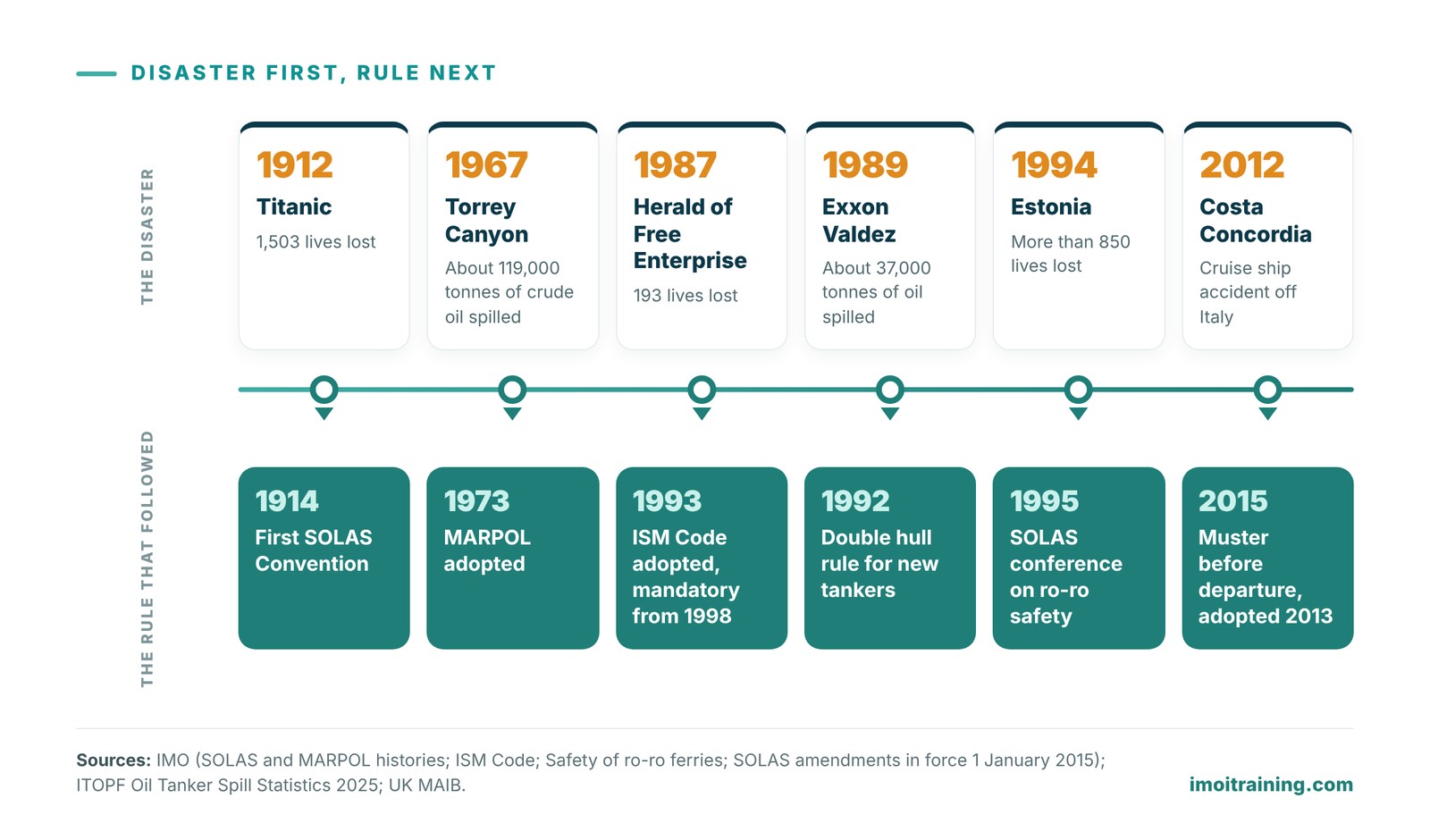
The timeline above shows six of these turning points. Three of them created the backbone of modern shipping rules.
How did the Titanic create SOLAS?
The Titanic sank in April 1912 with the loss of 1,503 lives. One of the hardest lessons was simple: there were not enough lifeboats for everyone on board.
In January 1914, 13 countries signed the first SOLAS Convention in London. Among other things, it required:
- Enough lifeboat space for every person on board
- A continuous radio watch at sea
- A North Atlantic ice patrol
The First World War stopped the 1914 Convention from entering into force. Even so, many countries adopted its provisions on their own.
New versions followed in 1929, 1948, 1960 and 1974. The 1974 Convention brought a clever change called “tacit acceptance”. Amendments now enter into force on a set date unless enough governments object. This is why SOLAS can keep up with new lessons instead of waiting decades.
Every lifeboat drill you attend carries a lesson that was paid for with 1,503 lives.
How did the Torrey Canyon lead to MARPOL?
In March 1967, the tanker Torrey Canyon ran aground on the Seven Stones reef, between Land’s End and the Isles of Scilly, near the entrance to the English Channel. She spilled her entire cargo, around 119,000 tonnes of crude oil. IMO later described it as the biggest oil pollution incident ever recorded up to that time.
The accident showed how unprepared the world was. Who could act to stop the pollution? Who would pay for the damage?
IMO answered with a series of new conventions on intervention, liability and compensation. Then, on 2 November 1973, it adopted the International Convention for the Prevention of Pollution from Ships, known as MARPOL.
A spate of tanker accidents in 1976 and 1977 led to a further Protocol in 1978. The combined MARPOL 73/78 entered into force on 2 October 1983.
Why do today’s tankers have double hulls?
In March 1989, the tanker Exxon Valdez ran aground in Prince William Sound, Alaska, spilling around 37,000 tonnes of oil.
Two big changes followed. In August 1990, the United States signed the Oil Pollution Act into law. At IMO, the 1992 MARPOL amendments required double hulls, or an approved equivalent design, for new oil tankers of 5,000 dwt and above delivered on or after 6 July 1996.
Every Oil Record Book entry you sign is part of the MARPOL system that Torrey Canyon helped create.
How did the Herald of Free Enterprise create the ISM Code?
On 6 March 1987, the ro-ro passenger ferry Herald of Free Enterprise left Zeebrugge, Belgium, with her bow doors open. Water poured onto the vehicle deck. She capsized about four minutes after passing the outer harbour wall, and 193 people died.
The formal investigation that followed found that this was not one person’s mistake. It was a chain of failures:
- The crew member responsible for closing the bow doors had fallen asleep in his cabin and did not hear the call to harbour stations.
- The officer responsible for making sure the doors were closed left the vehicle deck before anyone had closed them, apparently expecting the crew member to arrive.
- There was no indicator on the bridge to show whether the doors were open or closed.
- Masters had asked for such indicators in 1985 and 1986. Shore management turned the requests down.
- Under the company’s standing orders, the Master would assume the ship was ready for sea unless someone reported a problem.
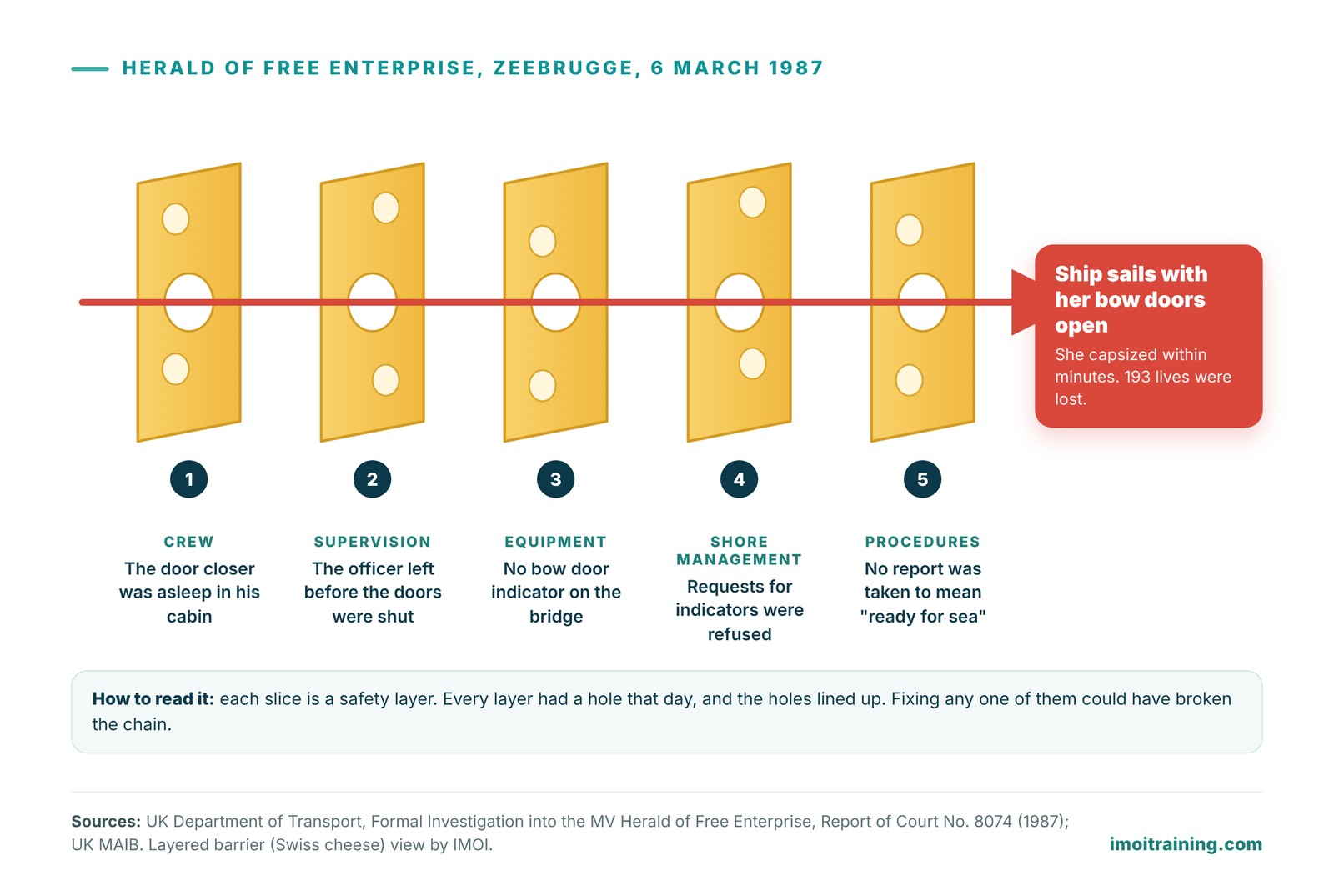
The court’s report contains one of the most quoted lines in shipping: “From top to bottom the body corporate was infected with the disease of sloppiness.”
The holes were not only on the car deck. They ran all the way up to the boardroom.
What changed after Zeebrugge?
Some fixes came fast. In April 1988, IMO adopted SOLAS amendments that required ro-ro passenger ships to have indicators on the bridge for doors that could cause major flooding if left open. These entered into force in October 1989.
The bigger change took longer. In 1987, the IMO Assembly asked for guidelines on how ro-ro passenger ships should be managed, both on board and ashore. Those guidelines grew, step by step, into the International Safety Management (ISM) Code, adopted in 1993.
The ISM Code became mandatory through SOLAS chapter IX on 1 July 1998. It applied first to passenger ships, including passenger high-speed craft, and to oil tankers, chemical tankers, gas carriers, bulk carriers and cargo high-speed craft of 500 gross tonnage and above. Other cargo ships and mobile offshore drilling units of 500 gross tonnage and above followed on 1 July 2002.
The ISM Code made safety clearly the company’s job, not just the ship’s. That is why every company today has a Safety Management System and a Designated Person Ashore with direct access to top management.
The ISM Code grew out of a disaster where a whole company, not just one sailor, let a ship sail with her doors open.
Did the pattern stop there?
No. The list kept growing.
- Estonia, 1994: The ro-ro ferry capsized in a severe storm in the Baltic Sea, with the loss of more than 850 lives. A SOLAS Conference on ro-ro passenger ship safety followed in 1995.
- Costa Concordia, 2012: After this cruise ship accident off Italy, IMO amended SOLAS. Since 1 January 2015, on voyages where passengers are scheduled to be on board for more than 24 hours, newly embarked passengers must muster before departure or immediately on departure.
Each rule in the book is a scar from a real event.
Why does this history matter on board today?
Because rules are easier to follow when you know why they exist. Here are four simple ways to use these stories.
Tell the story behind the drill
A muster drill feels like routine. It feels different when the crew knows about the Titanic’s lifeboats. Use these stories in toolbox talks and safety meetings.
Never treat silence as good news
On the Herald, no report meant “all is well”. It was not. Ask for positive confirmation: doors closed, valves set, lashings checked.
Report the small things
The ISM Code expects companies to have procedures for reporting accidents, hazardous situations and non-conformities. Small reports today prevent big headlines tomorrow.
Remember that safety starts ashore
The Herald inquiry found the company’s management at fault “from top to bottom”. Superintendents, managers and training heads shape safety as much as the crew does.
The cheapest safety lesson is the one you learn from someone else’s accident.
Want your team to spot the holes before they line up? IMOI’s Marine Accident Investigation and Root Cause Analysis course teaches how accidents really happen and how to find their root causes. Pair it with our Risk Assessment and Risk Management and Behavior Based Safety courses to build a stronger safety culture on board and ashore.
Frequently asked questions
Which disaster led to the creation of SOLAS?
The sinking of the Titanic in 1912. The first SOLAS Convention was signed in January 1914. It never entered into force because of the First World War, but it laid the foundation for the SOLAS Convention of 1974 that applies today.
Why was MARPOL created?
The Torrey Canyon oil spill of 1967 showed that the rules then in place on oil pollution from ships were not enough. MARPOL was adopted on 2 November 1973, strengthened by a Protocol in 1978, and entered into force on 2 October 1983.
What does the Herald of Free Enterprise have to do with the ISM Code?
The inquiry into the 1987 disaster found serious management failures, described as a “disease of sloppiness”. IMO then began work on management guidelines that grew into the ISM Code, adopted in 1993.
When did the ISM Code become mandatory?
On 1 July 1998, through SOLAS chapter IX, for passenger ships, including passenger high-speed craft, and for oil tankers, chemical tankers, gas carriers, bulk carriers and cargo high-speed craft of 500 gross tonnage and above. Other cargo ships and mobile offshore drilling units of 500 gross tonnage and above followed on 1 July 2002.
Why do oil tankers have double hulls?
After the Exxon Valdez spill in 1989, IMO adopted MARPOL amendments in 1992. New oil tankers of 5,000 dwt and above delivered on or after 6 July 1996 must have double hulls or an approved equivalent design.

About the author: Capt. Srirang Manjeshwar
Capt. Srirang Manjeshwar is senior faculty and Training Director at IMOI. A former Master on Suezmax, Aframax and ULCC oil tankers, he has trained marine personnel since 1995 and has helped train more than 750 cadets since 2000. He retired as Director and Head of Training at Wallem Maritime Training.
Sources
- International Maritime Organization (IMO), “SOLAS”, Knowledge Centre, Conferences and meetings. imo.org
- IMO, Focus on IMO, “Surviving disaster: life-saving at sea”, January 2000. wwwcdn.imo.org
- IMO, “History of life-saving appliances requirements”. imo.org
- IMO, Focus on IMO, “MARPOL: 25 years”, October 1998. wwwcdn.imo.org
- IMO, “MARPOL”, Knowledge Centre, Conferences and meetings. imo.org
- ITOPF, “Oil Tanker Spill Statistics 2025” and case study “Torrey Canyon, United Kingdom, 1967”.. itopf.org | itopf.org
- US Environmental Protection Agency (archive), “Oil Pollution Act Overview”. archive.epa.gov
- UK Marine Accident Investigation Branch (MAIB), “Flooding and capsize of ro-ro passenger ferry Herald of Free Enterprise with loss of 193 lives”. gov.uk
- UK Department of Transport, “MV Herald of Free Enterprise: Report of Court No. 8074, Formal Investigation”, 1987. assets.publishing.service.gov.uk
- IMO, “Safety of ro-ro ferries”. imo.org
- IMO, “Safety management and safety culture”. imo.org
- IMO, “The International Safety Management (ISM) Code”. imo.org
- IMO, Press briefing on SOLAS amendments entering into force on 1 January 2015. imo.org