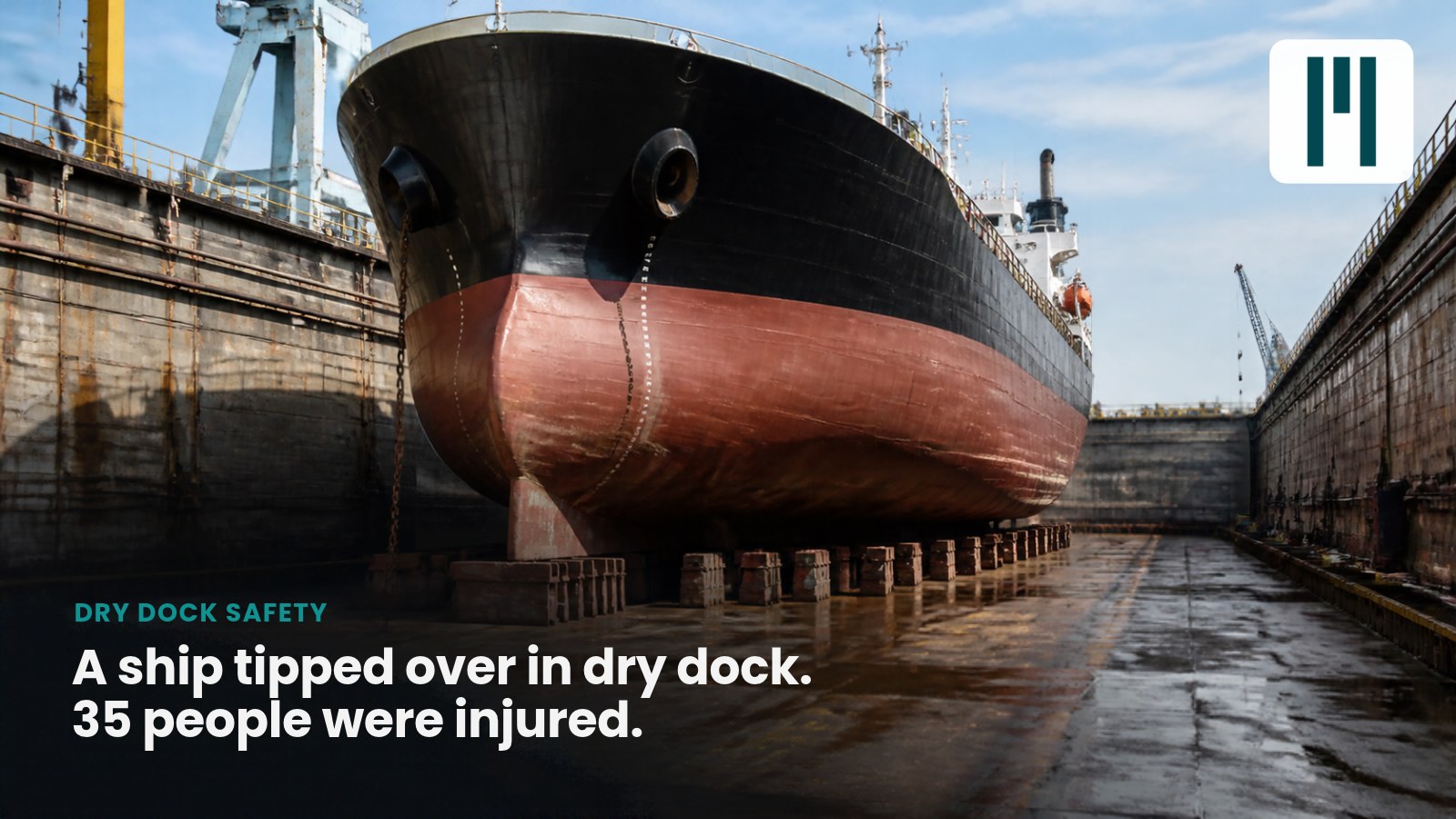
On the morning of 22 March 2023, a 76-metre research ship tipped over inside a dry dock in Leith, Edinburgh. She came to rest leaning at about 45 degrees. Thirty-five people were injured.
The ship was not at sea. She had not hit anything. She was standing in a dock while people worked on her.
Most of us feel a little safer when a ship goes into dry dock. The sea can no longer reach her. The engines are quiet. The pressure of the voyage is gone.
But a shipyard brings a different kind of danger. And because it does not look dangerous, it is easy to underestimate.
Here are the five dangers that matter most for dry dock safety, what real investigations have taught us, and how a simple plan keeps everyone on site safe.
Why the risk changes the moment a ship enters the yard
A ship in dry dock is a ship, a factory and a construction site, all at once.
Welders, painters, riggers, scaffolders and the ship’s own crew may all be working within a few metres of each other. Most of them work for different companies. They follow different procedures. And they all share the same tight deadline.
That mix is exactly what the International Marine Contractors Association (IMCA) set out to address in its updated Guidance on safety in shipyards, revised in August 2025. The guidance covers dry docking and longer maintenance periods. One of the problems it highlights is confusion over responsibilities between the ship’s crew, shipyard staff and subcontractors.
When nobody is sure who is in charge, small gaps open up. Accidents start in those gaps.
Five dangers every dry dock safety plan must cover
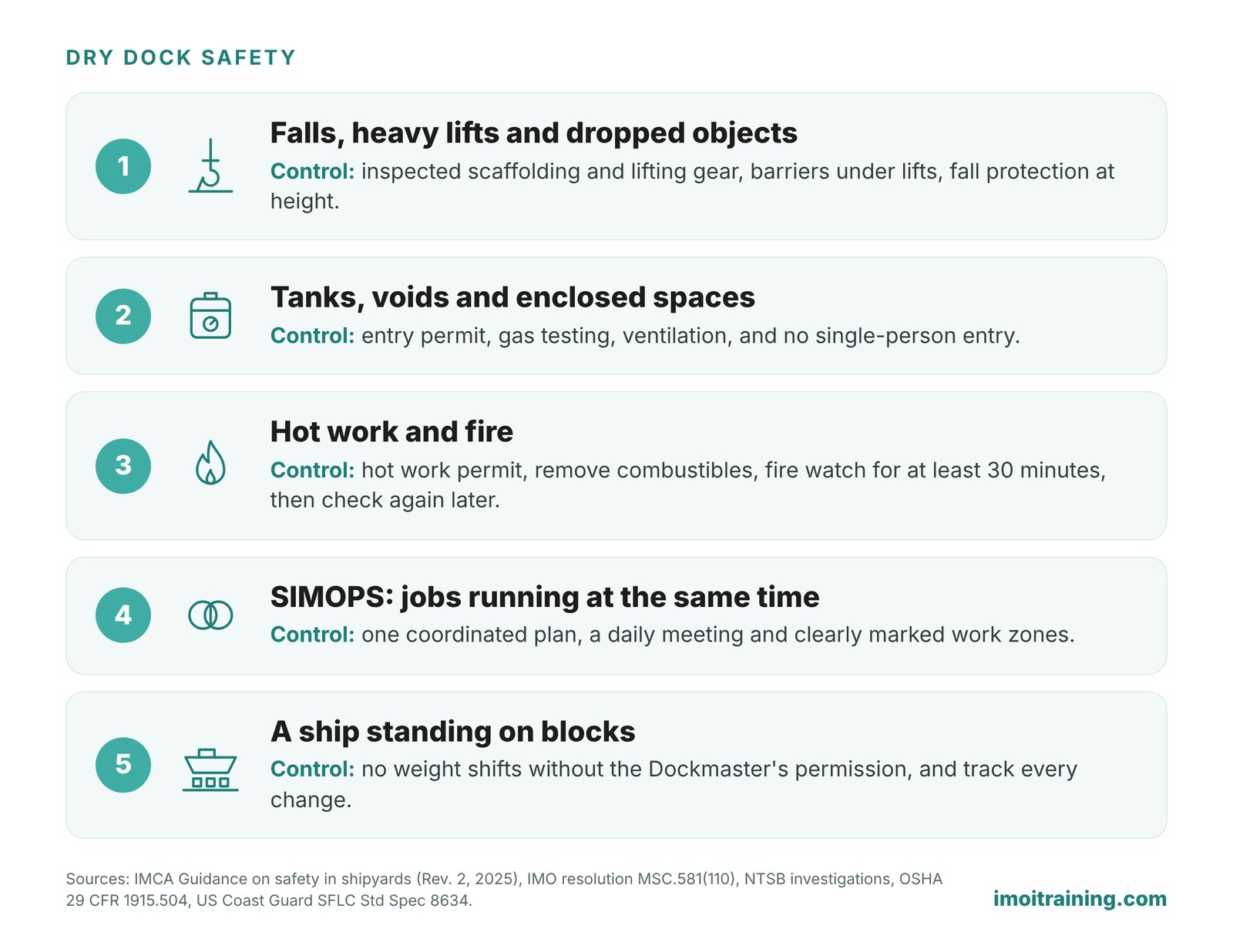
1. Falls, heavy lifts and dropped objects
Scaffolding goes up around the hull. Cranes swing heavy loads over people’s heads. People work on tank tops, hatch covers and staging, with the dock floor far below.
IMCA notes that shipyard work exposes people to falls, fires, chemical exposure and machinery accidents. The controls for work at height and lifting are well known: inspected scaffolding and lifting gear, proper rigging by competent people, barriers under lifting zones and fall protection wherever someone could fall.
The hard part is not knowing the rules. It is making sure they are followed on every shift, by every contractor.
2. Tanks, voids and other enclosed spaces
During a repair period, tanks and void spaces that stay closed for months are opened, cleaned, painted and repaired. The air inside can lack oxygen. It can also hold toxic or flammable gases.
In June 2025, the IMO adopted revised Recommendations for entering enclosed spaces aboard ships, resolution MSC.581(110). They replace the earlier resolution A.1050(27). The key points include a ship-specific register of enclosed spaces and their hazards, an entry permit, proper atmosphere testing and clear guidance that companies should not allow single-person entry.
The recommendations are written for shore personnel working on board as well as for seafarers. In a shipyard, that matters. The person climbing into the tank may not be a crew member at all.
3. Hot work and fire
Welding, cutting, grinding and burning throw out sparks and hot slag. In a shipyard, this often happens close to paint, insulation, oil residue and stored materials.
The fish processing vessel Aleutian Falcon shows how quickly this can go wrong. On 17 February 2021, while she was moored at a shipyard pier in Tacoma, Washington, for repairs, a fire broke out on board. The US National Transportation Safety Board (NTSB) found that slag from hot work ignited combustible material near an insulated wooden bulkhead, which had not been removed or properly protected.
The fire burned for more than four days. The vessel was declared a constructive total loss, valued at about US$16.5 million. Fortunately, nobody was on board.
The NTSB pointed to three failures. The hot work was not planned properly. The work area was not adequately protected. And communication between supervisors, the marine chemist and the workers was poor.
There is another lesson in hot work fires. A fire does not always start while the torch is burning.
That is why a fire watch should not end the moment the welder packs up. Under the US shipyard fire protection rules, OSHA 29 CFR 1915.504, a fire watch must stay in the hot work area for at least 30 minutes after the work is finished. The only exception is when the area has been checked and found free of any further fire hazard. The same rule says a fire watch must not be given other duties during hot work, and has the authority to stop the work.
But even 30 minutes is a minimum, not a guarantee. In March 2024, the bulk carrier Cuyahoga was moored for winter maintenance in Ashtabula, Ohio. After hot work in a cargo hold, the area was watched for the required 30 minutes. The fire was discovered about 105 minutes after the hot work had finished. The NTSB said the fire possibly started from smouldering linked to the earlier hot work, and warned that “a smoldering fire can long outlast the time a fire watch observes an area following hot work.”
So treat 30 minutes as the starting point. Go back and check the area again later, including the spaces on the other side of the bulkhead.
4. Two safe jobs that become one dangerous job
This danger is the easiest to miss.
Each job has its own permit and its own risk assessment. On paper, each one looks safe. Put them side by side, and the picture changes.
Imagine a crane lifting a load over scaffolding, while a welder works inside a tank next to it and a painting team works one deck below. Each job may be correct on its own. Together, they can mean a load swinging over people, sparks close to fresh paint or fumes drifting into a space where people are working.
This is known as SIMOPS, short for simultaneous operations. The answer is coordination: one plan that shows every job in the same area, a daily meeting where those jobs are agreed, clearly marked work zones and a clear decision on which jobs must not run together.
5. A ship standing on blocks
In dry dock, the ship’s whole weight rests on keel blocks and side blocks. Her safety now depends on those blocks being set up correctly, and on the weight on board staying under control.
Pumping ballast, removing heavy equipment or moving stores all change how that weight is spread. Good dry docking practice takes this seriously. The US Coast Guard’s standard dry-docking specification for its own vessels, for example, says that no weights, fuel, fresh water or ballast may be shifted while the vessel is docked without the Dockmaster’s permission. It also requires weight changes during the dock period to be tracked.
The Leith incident is a clear reminder of how many people can be hurt when a docked ship moves. Its cause is for the investigators to establish. The Health and Safety Executive and Police Scotland opened a joint investigation, and we have not seen any published findings, so we will not guess.
Who is in charge when the ship is in the yard?
At sea, the chain of command is clear. In a shipyard, it is not.
The ship’s crew, the owner’s superintendent, the shipyard’s own safety team and a long list of subcontractors all share the same space. Each brings its own procedures and its own idea of what “safe” means.
Good dry dock safety starts by agreeing one standard that everyone follows. In practice, that means:
- clear lines of responsibility, agreed before the ship arrives
- a permit-to-work system for hot work, enclosed space entry and work at height
- lockout and tagout (LOTO), so that machinery and systems cannot be started while someone is working on them
- daily coordination meetings and short toolbox talks before work begins
- Stop Work Authority for every single person on site
Stop Work Authority means that anyone, from the youngest rating to the yard manager, can stop a job they believe is unsafe, without fear of blame. It only works if people believe it. That belief grows when leaders thank people for stopping work, even when the stop turns out to be unnecessary.
A safe dry dock plan, step by step
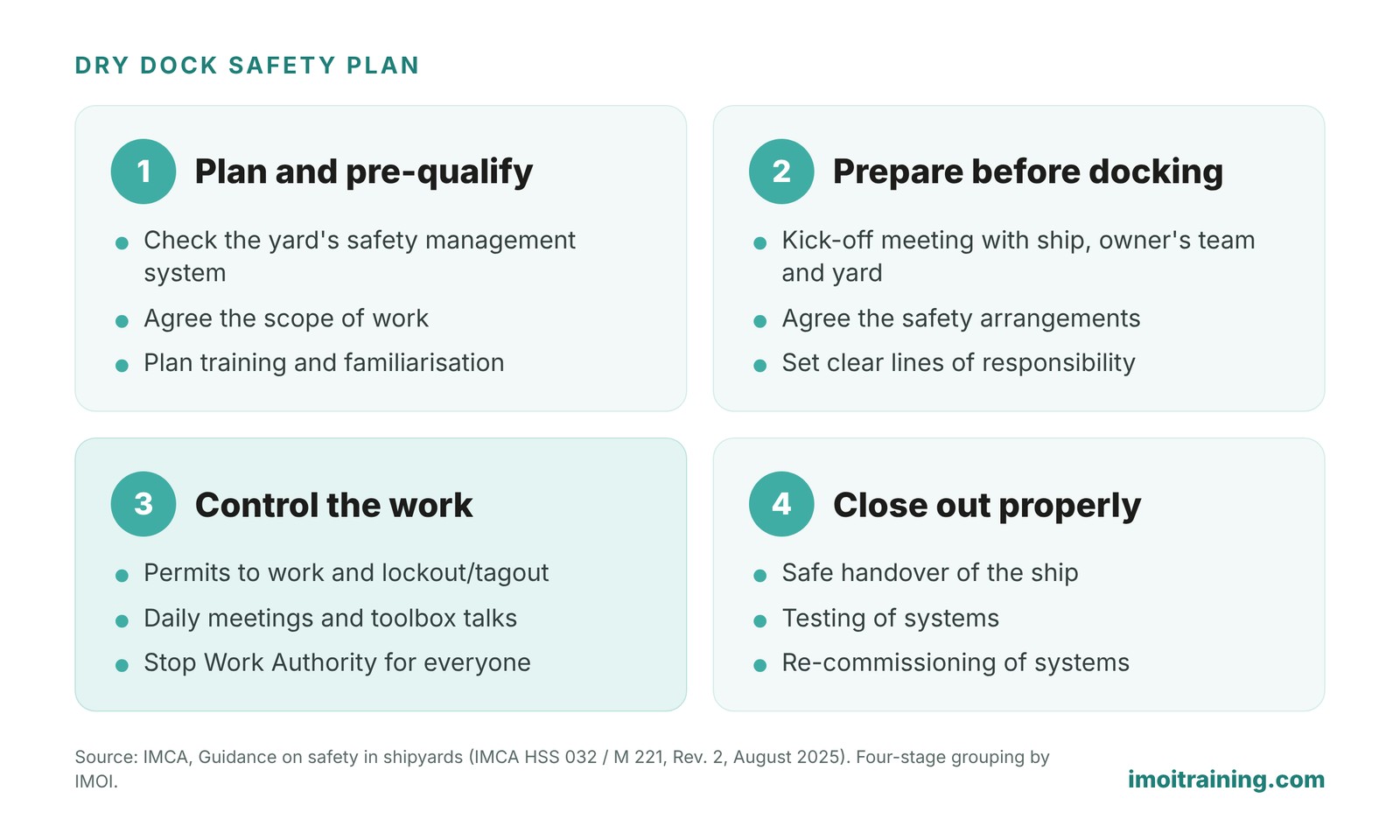
IMCA’s guidance follows a shipyard project from pre-qualification to handover. Grouped into four simple stages, it looks like this:
- Plan and pre-qualify. Check the yard’s safety management system, agree the scope of work and plan training and familiarisation.
- Prepare before docking. Hold a kick-off meeting with the ship, the owner’s team and the yard, and agree the safety arrangements before any work starts.
- Control the work. Manage traffic, lifting, work at height, scaffolding, hot work and enclosed space entry. Use permits, LOTO, management of change, daily meetings, toolbox talks, event reporting, Stop Work Authority and a clear emergency response.
- Close out properly. Hand the ship back with testing and re-commissioning of her systems.
The guidance also includes sample tender documents and a generic HSE audit questionnaire for shipyards. For a superintendent preparing a docking, that makes it a practical checklist.
What an accident really costs
The direct cost of an accident is easy to see: medical care, repairs and the investigation.
The indirect cost can be far bigger. Work stops. The ship’s return to service slips. Commercial plans change. Legal claims and damage to reputation can follow.
Sometimes the ship never comes back at all. Both the Aleutian Falcon and the Cuyahoga were declared constructive total losses after their fires, with estimated values of about US$16.5 million and US$11 million.
The best time to plan for safety
A dry dock period is short, busy and expensive. That is exactly why safety cannot wait until the work has started.
The best time to agree the safety plan is before the first weld, not after the first incident.
Planning a dry docking? IMOI’s Drydocking and Repairs Management course covers dry dock preparation, specifications, project management and the role of class. To build safer teams on board and ashore, see our Risk Assessment and Risk Management, Behavior Based Safety and Marine Accident Investigation and Root Cause Analysis courses.
Frequently asked questions
What is dry docking?
Dry docking means taking a ship out of the water so that she rests on blocks in a dock. This allows the hull and underwater parts, such as the propeller and rudder, to be inspected, repaired and painted.
What are the main hazards in a dry dock?
The main hazards include falls and dropped objects, enclosed spaces with unsafe air, fires from hot work, the risks created when several jobs run at the same time (SIMOPS) and the stability of the ship on her blocks.
Who is responsible for safety when a ship is in a shipyard?
Responsibility is shared between the shipowner and crew, the shipyard and its subcontractors. Because this can cause confusion, the roles should be agreed in writing before the ship arrives, with one common safety standard for everyone on site.
What is Stop Work Authority?
Stop Work Authority is the right of any person on site to stop a job they believe is unsafe, without fear of blame or punishment.
Is there international guidance on shipyard safety?
Yes. IMCA’s Guidance on safety in shipyards (IMCA HSS 032 / M 221, Rev. 2, August 2025) covers dry docking and longer maintenance periods. The ILO code of practice Safety and health in shipbuilding and ship repair, adopted in 2018, gives wider guidance for the industry. The IMO’s revised Recommendations for entering enclosed spaces aboard ships, resolution MSC.581(110), cover enclosed space entry.

About the author: Capt. Srirang Manjeshwar
Capt. Srirang Manjeshwar is senior faculty and Training Director at IMOI. A former Master on Suezmax, Aframax and ULCC oil tankers, he has trained marine personnel since 1995 and has helped train more than 750 cadets since 2000. He retired as Director and Head of Training at Wallem Maritime Training.
Sources
- IMCA, Guidance on safety in shipyards (IMCA HSS 032 / M 221, Rev. 2, August 2025): imca-int.com
- IMCA news, “IMCA publishes updated guidance on safety in shipyards”, 10 September 2025
- IMO resolution MSC.581(110), Revised Recommendations for entering enclosed spaces aboard ships, as summarised by IRClass Technical Circular 002/2026 and DNV
- NTSB, Fire aboard fishing vessel Aleutian Falcon, investigation DCA21FM016 (MIR-22-10)
- NTSB, Fire aboard bulk carrier Cuyahoga, investigation DCA24FM027 (MIR-25-38)
- OSHA, 29 CFR 1915.504, Fire watches
- US Coast Guard, SFLC Standard Specification 8634 (2018), Dry-docking
- ILO, Safety and health in shipbuilding and ship repair, code of practice (revised edition)
- STV News, report on the Petrel incident at Imperial Dock, Leith, 23 March 2023