It was a December night in 2024. A 333 m container ship was approaching the port of Keelung, Taiwan.
A local pilot was on board. The main engine, the steering gear and the navigation equipment were all working normally. The master, the bridge team and the pilot all held valid certificates, and investigators found no evidence of fatigue.
At about 2310 on 11 December 2024, the ship ran aground on the port’s west breakwater.
Nobody was hurt and there was no pollution. But the final report of the Taiwan Transportation Safety Board (TTSB) points to a weak link that every bridge team should recognise: the master pilot exchange.
Here is what happened to the YM Unicorn, what the master pilot exchange is meant to do, and 4 lessons any bridge team can take into its next port entry.
What happened to the YM Unicorn at Keelung?
She ran aground because she was still on the eastern side of the channel as she neared the entrance. She was also going too fast, with too little propeller wash for her rudder to turn her in time.
That is the short version of the TTSB’s probable causes. Here is the longer one.
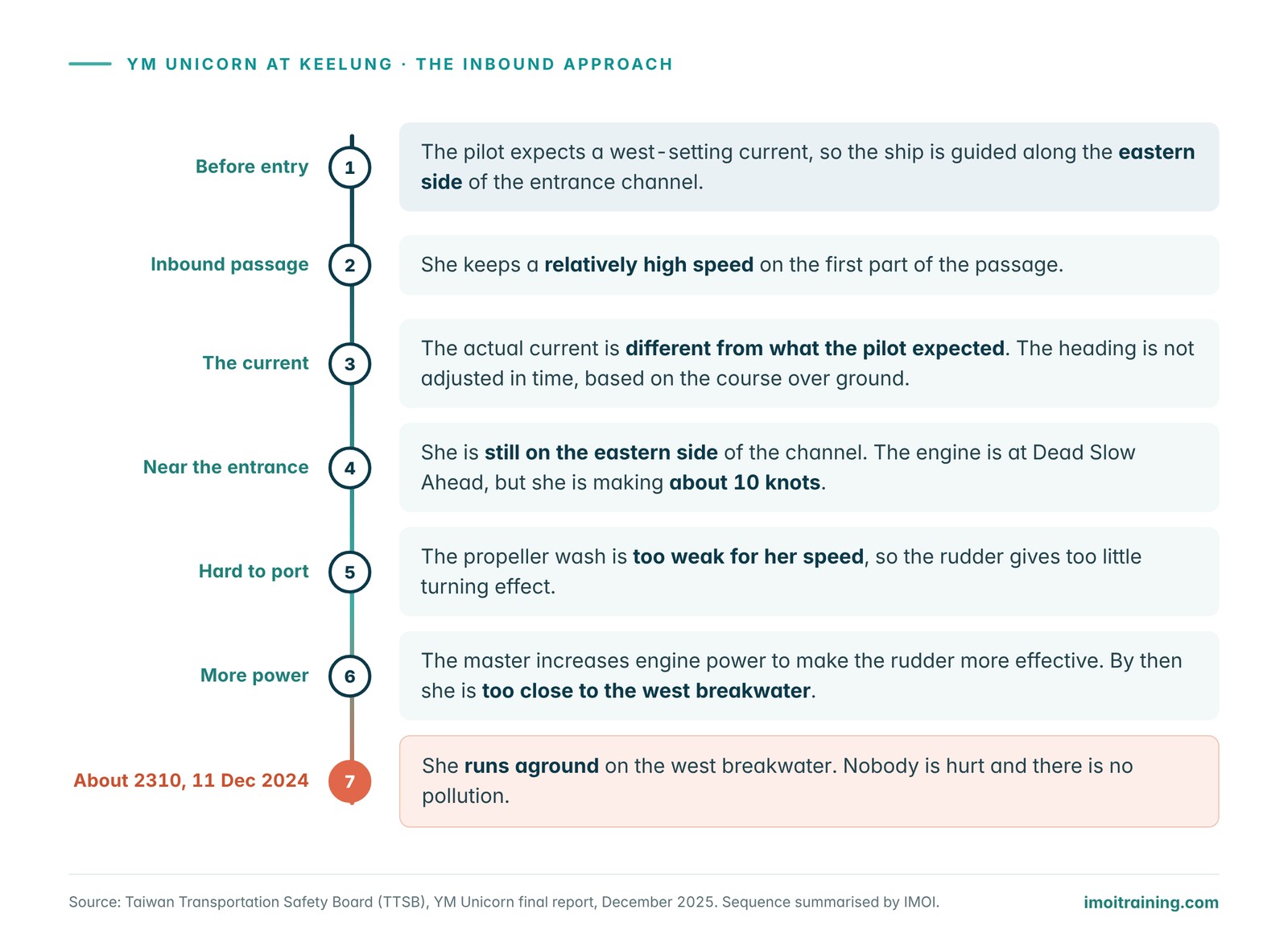
Before entering port, the pilot expected a west-setting current. So the ship was guided along the eastern side of the entrance channel.
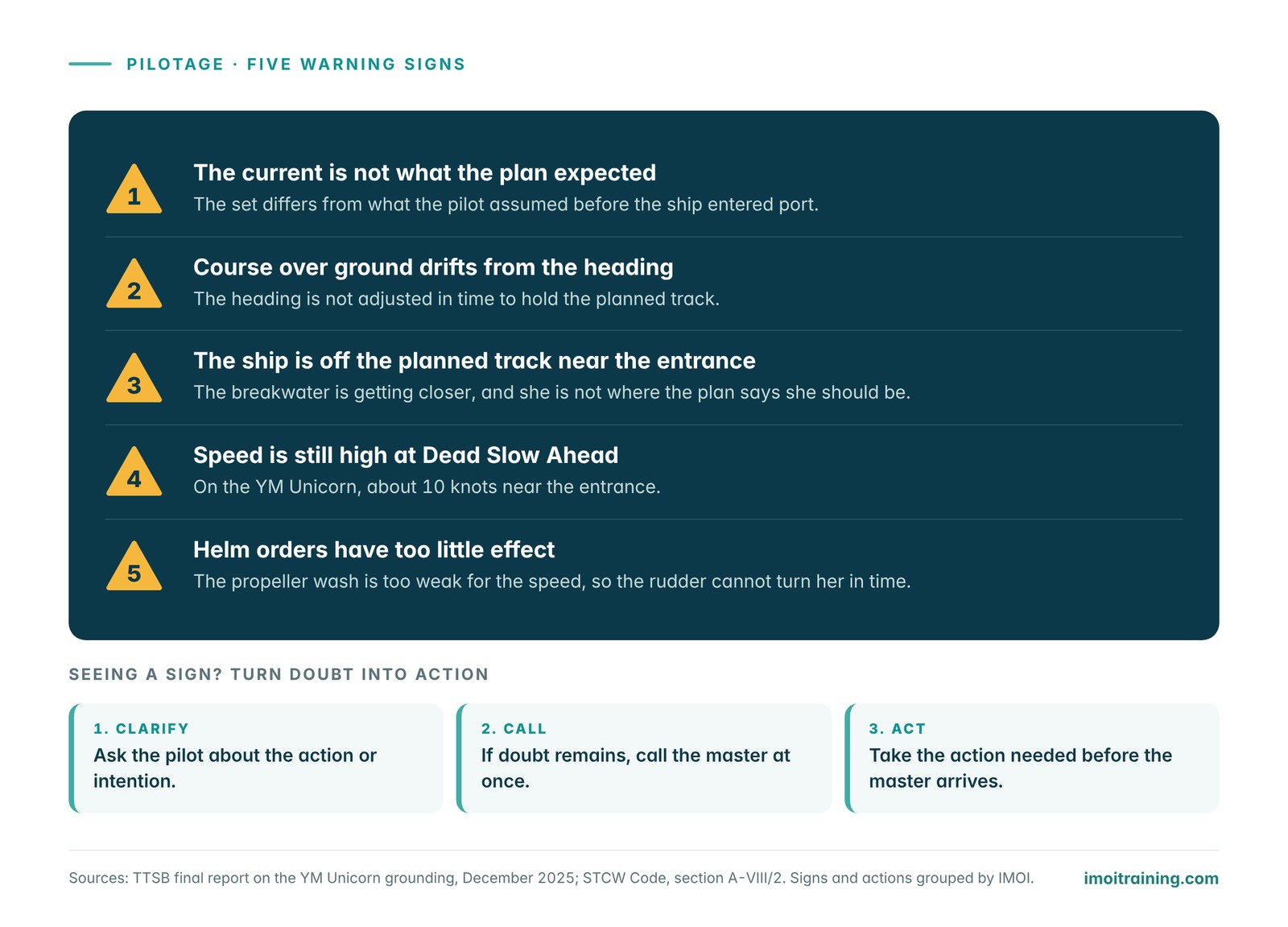
The actual current was different from what the pilot expected. The ship’s heading was not adjusted in time, based on her course over ground (COG). As she approached the breakwater entrance, she was still on the eastern side of the channel.
She had kept a relatively high speed on the first part of the inbound passage. Near the entrance, the engine was at Dead Slow Ahead, but the ship was still making about 10 knots.
The helm was put hard to port. The TTSB found that the propeller wash was too weak for the ship’s speed, so the rudder did not produce enough turning effect. The master then increased engine power to make the rudder more effective. By then the ship was too close to the west breakwater, and she ran aground.
That night, the sea area off Keelung had a north-northeasterly wind averaging 24 knots. Inside the port, the tide was ebbing, about 1.5 hours before low water.
Nothing on board was broken. But the TTSB found that the pilot’s plan was never fully shared with the bridge team, and that this raised the risk.
What is the master pilot exchange?
It is the exchange of information between the master and the pilot. It starts when the pilot boards and normally continues until the pilot leaves.
IMO’s recommendations for pilots, resolution A.960(23), say that each pilotage should begin with this exchange. They say it should generally continue for the whole pilotage. At a minimum, it should include:
- the ship’s pilot card and manoeuvring data, such as turning circles and stopping distances
- general agreement on plans and procedures, including contingency plans, for the passage
- special conditions such as weather, depth of water, tidal currents and traffic
- any unusual handling characteristics, machinery problems, equipment faults or crew limitations
- berthing and mooring arrangements, and the use of tugs
- the language to be used on the bridge and with outside parties
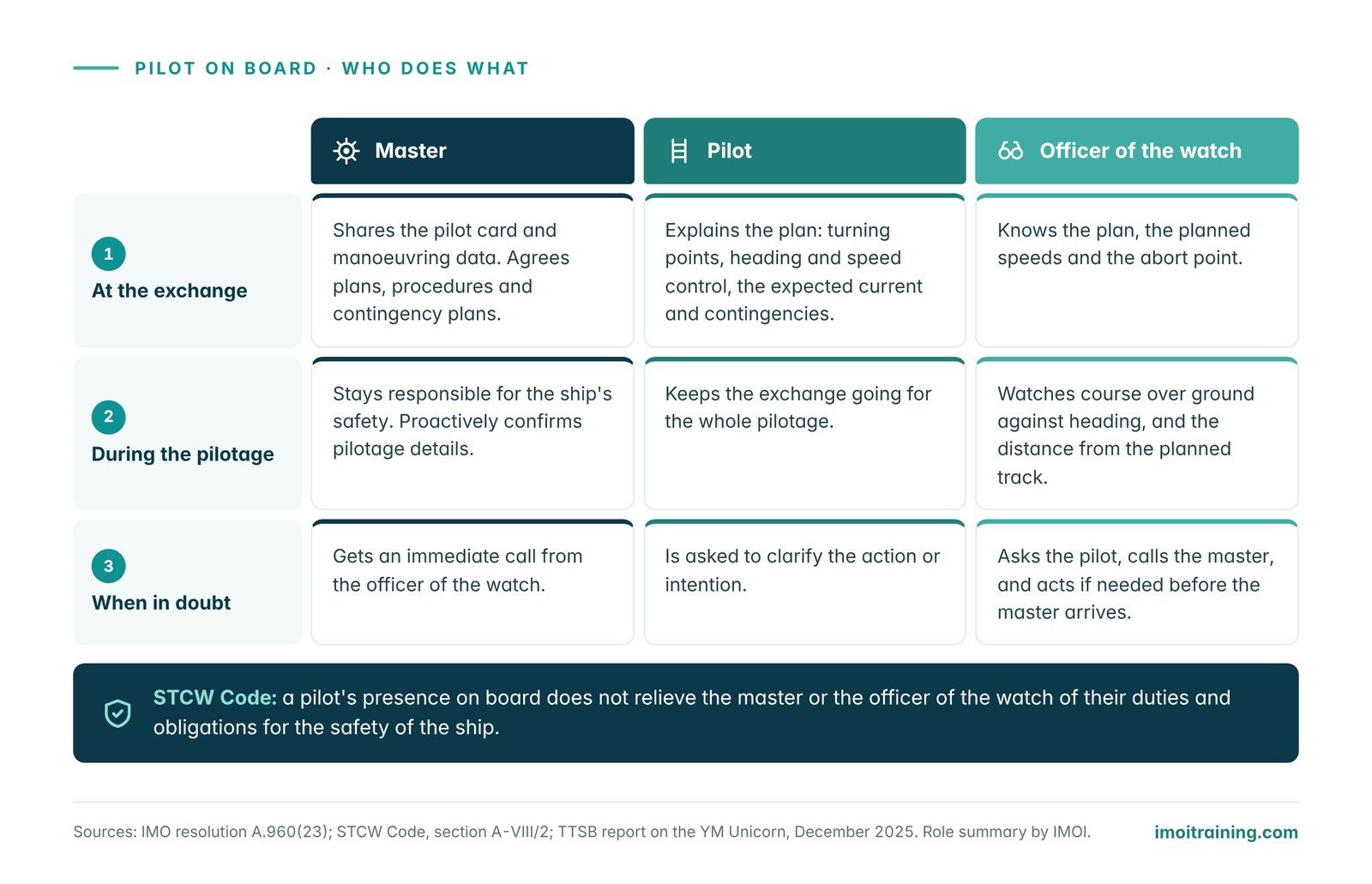
The STCW Code adds the most important rule of all. A pilot’s presence on board does not relieve the master or the officer of the watch of their duties and obligations for the safety of the ship.
The pilot brings local knowledge. The bridge team still owns the ship’s safety.
What did the investigation find about the exchange on the YM Unicorn?
It found that the exchange was not carried out in line with IMO resolution A.960(23), so the bridge team never had the full picture.
According to the TTSB:
- The pilot did not give the bridge team complete and clear information on the inbound manoeuvring strategy, the risk assessment and the contingency plans. The pilot also did not provide the pilotage plan and supporting information required by Taiwan’s own pilot regulations.
- The company’s Navigation Safety Manual did not say what the exchange should cover, such as the pilotage plan or sea and weather conditions.
- The voyage plan had no contingency plan for the port entry, such as abort points or alternative actions. So when the ship kept moving away from the intended track, the bridge team had no clear point at which to step in.
The bridge team was not silent. They asked the pilot several times about the ship’s heading and position. But they did not recommend corrective action or intervene in the manoeuvre.
They saw the problem and asked about it. Questions alone did not change the ship’s track.
The TTSB said this was consistent with findings from its earlier investigations involving pilotage. In its view, the risk is systemic rather than isolated.
When decisions rest on one person’s judgement, the bridge team is more likely to miss the chance to correct a mistake.
What are the 4 lessons for every bridge team?
Each lesson below is built on the TTSB’s findings and safety recommendations.
1. Ask for the pilot’s plan, not just the pilot card
The exchange works both ways. The master hands over the pilot card. The pilot should explain the plan.
The TTSB asked the Keelung pilot office to make sure the exchange covers heading and speed control strategies, turning points, port-specific considerations and contingency arrangements.
So ask for those, every time. Where will we turn? How fast will we go? What current do you expect, and what will we do if it is different?
The TTSB also noted that some major international ports, such as those in Japan, provide written pilot information cards. Written details back up what is said, and help the master and the pilot reach the same understanding.
2. Agree on an abort point before you need it
An abort point is an agreed position after which it is no longer safe to give up the approach. Before it, the team can still slow down, turn away or wait.
The YM Unicorn’s voyage plan had no abort points or alternative actions for the port entry. The TTSB found that this left the bridge team without clear criteria for when to intervene.
IMO’s Guidelines for voyage planning, resolution A.893(21), already expect contingency plans. These include alternative action to take the ship into deep water, or to a port of refuge or safe anchorage, if the plan has to be abandoned.
An abort point turns a vague worry into a clear decision that everyone agreed on in advance.
3. Plan the speed for every leg of the approach
Speed was a key part of this grounding. Near the entrance, the engine was at Dead Slow Ahead, but the ship was still making about 10 knots.
The TTSB found that the propeller wash was too weak for that speed, so the hard-to-port helm order did not turn the ship enough. When the master increased power to give the rudder more effect, there was no room left.
So plan the speed for each leg of the approach with the pilot. Agree what the team will do if the ship is faster than planned at a key point, such as the breakwater entrance.
4. Turn doubt into action: clarify, call, act
The STCW Code is clear about what the officer of the watch must do when in doubt about the pilot’s actions or intentions:
- Ask the pilot for clarification.
- If doubt still exists, notify the master immediately.
- Take whatever action is necessary before the master arrives.
The YM Unicorn’s bridge team did ask. What was missing, the TTSB found, was the next step: recommending corrective action or stepping in.
Doubt is easier to act on when you can point to a number. Watch the course over ground against the heading, and the ship’s distance from the planned track. If they keep moving the wrong way, say so early and in plain words.
A question is only the start. The bridge team must be ready to turn it into action.
Why practise this on a simulator?
Because the TTSB itself recommended scenario-based training for exactly this situation.
It asked Yang Ming Marine Transport Corporation to add Bridge Resource Management (BRM) exercises to its crew training. These exercises should focus on pilotage during port entry and departure, including how to monitor and how to intervene when hazards or abnormalities appear.
It also asked the company to write a rule into its Safety Management System: masters must proactively confirm pilotage details with the pilot. Internal audits should check this.
A simulator is the safe place to practise all of it: the exchange, the abort point, the effect of speed and current, and the moment someone has to say stop.
A team that has practised challenging a pilot on a simulator will find the words faster on a real night.
Want your bridge team ready to plan, question and act with a pilot on board? IMOI’s Bridge Team Resource Management (BTRM) course, which complies with IMO Model Course 1.22, builds communication, situational awareness and a shared mental model on the bridge, with practice on ARI simulators. Add our Large Vessel Ship Handling Simulator course to practise slow-speed control and stopping on a simulator. Our self-paced Ship Handling Basics course covers the basics of manoeuvring in confined waters.
Frequently asked questions
What is the master pilot exchange?
It is the exchange of information between the master and the pilot. It begins when the pilot boards and should generally continue throughout the pilotage. IMO resolution A.960(23) sets out what it should include, from the pilot card to contingency plans.
Is the master still responsible when a pilot is on board?
Yes. The STCW Code says that a pilot’s presence on board does not relieve the master or the officer of the watch of their duties and obligations for the safety of the ship.
What should the master pilot exchange include?
At least the pilot card and manoeuvring data, and agreement on plans and procedures, including contingency plans. It should also cover the expected weather, depths, tidal currents and traffic, any handling, machinery, equipment or crew limitations, berthing, tug and mooring arrangements, and the working language.
What is an abort point in passage planning?
It is an agreed position after which it is no longer safe to give up the approach. Before it, the bridge team can still slow down, turn away or wait. IMO’s voyage planning guidelines expect contingency plans in case a plan has to be abandoned.
Why did the YM Unicorn run aground?
According to the TTSB, the current was different from what the pilot expected, and the ship’s heading was not corrected in time. She was still making about 10 knots near the entrance. The propeller wash was too weak for that speed, so the rudder could not turn her in time.

About the author: Capt. Srirang Manjeshwar
Capt. Srirang Manjeshwar is senior faculty and Training Director at IMOI. A former Master on Suezmax, Aframax and ULCC oil tankers, he has trained marine personnel since 1995 and has helped train more than 750 cadets since 2000. He retired as Director and Head of Training at Wallem Maritime Training.
Sources
- Taiwan Transportation Safety Board (TTSB), “TTSB Releases Final Report on Container Vessel YM Unicorn Grounded at West Breakwater of Keelung Port”, 17 December 2025. https://www.ttsb.gov.tw/english/16051/16113/16114/49147/post
- TTSB, “A Container Vessel YM UNICORN Grounded at West Breakwater of Keelung Port”, occurrence page. https://www.ttsb.gov.tw/english/18609/28176/44603/post
- IMO resolution A.960(23), Recommendations on training and certification and operational procedures for maritime pilots other than deep-sea pilots, Annex 2, section 5, as reproduced in IMPA, “Guidance on the Master-Pilot Exchange (MPX)”. https://www.impahq.org/sites/default/files/2021-04/IMPA%20Guidance%20on%20the%20Master%20-%20Pilot%20Exchange%20%28MPX%29.pdf
- STCW Code, section A-VIII/2, part 4-1, navigation with pilot on board, as set out in AMSA, “Watchkeeping standards” (AMSA 242). https://www.amsa.gov.au/sites/default/files/amsa242-watchkeeping-standards.pdf
- IMO resolution A.893(21), Guidelines for voyage planning, Annex 1 to MPA Singapore Shipping Circular No. 16 of 2010. https://www.mpa.gov.sg/docs/mpalibraries/circulars-and-notices/shipping-circulars/-sc_no_16_of_2010