In 2025, an estimated 1,478 containers were lost at sea. In 2024, the figure was 576.
Even 1,478 is a tiny share of the roughly 280 million containers carried in 2025. One ship loss alone accounted for 640 of them, and bad weather and fires also played a big part.
But every box that goes over the side is a hazard to other ships and a cost to the owner.
When cargo is lost or damaged, the same questions often follow. Was it stowed and lashed the way the approved manual says? Were the weights right? Was the securing gear in good condition?
Right now, port State control officers are asking exactly these questions. Until 30 November 2026, the Paris and Tokyo MoUs are running a joint Concentrated Inspection Campaign on cargo securing.
This guide explains what the campaign covers, what the inspector will ask, which answers can lead to detention, and a simple way to get your team ready, even after the campaign ends.
What is the 2026 cargo securing campaign?
A Concentrated Inspection Campaign, or CIC, is a three-month period in which port State control (PSC) officers look closely at one subject during their routine inspections. In 2026, that subject is cargo securing.
The Paris MoU and the Tokyo MOU are running the campaign together from 1 September to 30 November 2026. The Black Sea MoU is running its own cargo securing campaign in its region, on the same dates.
Here is how it works:
- PSC officers use a dedicated questionnaire alongside the normal inspection.
- Each ship gets only one CIC inspection per MoU during the campaign.
- The focus is the loading, stowage and securing of cargo units and cargo transport units, such as containers, vehicles, pallets, portable tanks and packaged units.
- The results will be analysed and presented to the governing bodies of both MoUs, with a view to a later submission to the International Maritime Organization (IMO).
In other words, inspectors are collecting evidence, and your ship may become part of it.
Why is cargo securing in focus?
Because badly secured cargo puts everyone at risk. As the Australian Maritime Safety Authority (AMSA) puts it, cargo that is not properly loaded, stowed and secured can pose a serious risk to the vessel, the crew and other ships.
The rule itself is simple. SOLAS chapter VI, regulation 5, requires cargo units, including containers, to be loaded, stowed and secured throughout the voyage in line with the ship’s Cargo Securing Manual (CSM).
The manual must be approved by the flag Administration. It must also meet a standard at least equivalent to IMO’s guidelines, currently MSC.1/Circ.1353/Rev.2.
This is not the first campaign of its kind. The Tokyo MOU ran one on cargo securing in 2016, and AMSA ran a three-month container campaign in 2020. According to Gard, the 2020 campaign found that lashing gear was generally maintained to a reasonable standard. However, many officers could not show a sufficient understanding of the approved manual. The most serious findings were excessive stack weights, poor weight distribution and inadequate securing.
A manual on the shelf is not enough. Inspectors want to see that the crew understands it and follows it.
What will the PSC officer ask?
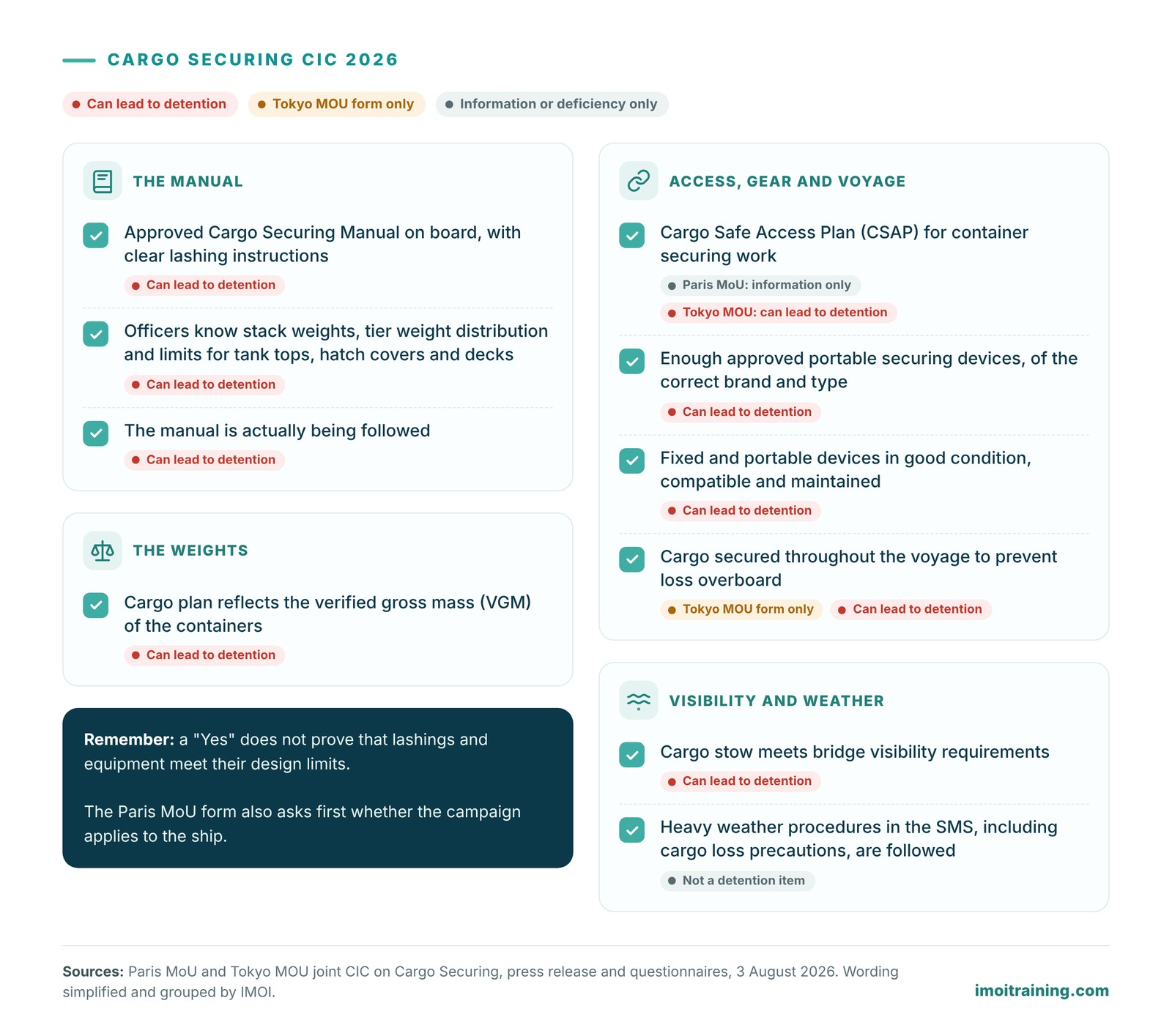
The Paris MoU and the Tokyo MOU check the same core points. Their questionnaires are just numbered a little differently. Here are the checks in plain words.
The manual
- Is there an approved CSM on board, with clear lashing instructions for every stowage situation on the ship?
- Are the relevant officers familiar with the manual, especially container stack weights, tier weight distribution and the weight limits for tank tops, hatch covers and decks?
- Is the manual actually being followed?
The second check tests people, not paper. An officer should be able to say, in plain words, what the stack weight limit is and where to find it in the manual.
The weights
- Does the cargo plan reflect the verified gross mass (VGM) of the containers being loaded?
VGM is the confirmed weight of a packed container. Under SOLAS chapter VI, regulation 2, as amended from 1 July 2016, it is a condition for loading. The shipper must provide it using one of two methods:
- Method 1: weigh the packed container on calibrated and certified equipment.
- Method 2: weigh all the contents, including pallets, dunnage and securing material, then add the empty container’s weight, using a certified method approved by the competent authority.
Access, gear and the voyage
- Does the ship have a Cargo Safe Access Plan (CSAP) to support the proper stowage and securing of containers?
- Does the ship carry enough approved portable securing devices, of the correct brand and type, to secure the cargo as the manual requires?
- Are the fixed and portable securing devices in good condition, compatible with the ship and maintained under the manual’s inspection and maintenance scheme?
- On the Tokyo MOU form only: has the cargo been secured throughout the voyage to prevent the loss of cargo overboard?
Visibility and weather
- Does the cargo stow comply with bridge visibility requirements?
- Does the ship have heavy weather procedures in its Safety Management System, including precautions against cargo loss, and are they followed?
Which answers can lead to detention?
A “No” to any question marked with an asterisk means the ship may be considered for detention. This is where the two forms differ:
- Paris MoU: 10 questions. Question 1 simply records whether the campaign applies to the ship. A “No” to seven of them (questions 2, 3, 4, 5, 7, 8 and 9) may lead to detention. The CSAP question is for information only.
- Tokyo MOU: there is no applicability question, and one extra question on securing throughout the voyage. A “No” to questions 1 to 9, including the CSAP question, may lead to detention.
On both forms, the heavy weather questions are not detention items, although a “No” can still be recorded as a deficiency.
The Paris MoU questionnaire also carries a note worth remembering. A “Yes” to any question does not prove that the lashing arrangement and equipment meet their design limits.
Passing the checklist is the minimum, not the finish line.
Where does cargo securing usually go wrong?
Many problems sit in the gap between what the manual says and what happens on deck. Looking at earlier inspection campaigns, P&I club NorthStandard found that procedures were typically in place but not always applied correctly.
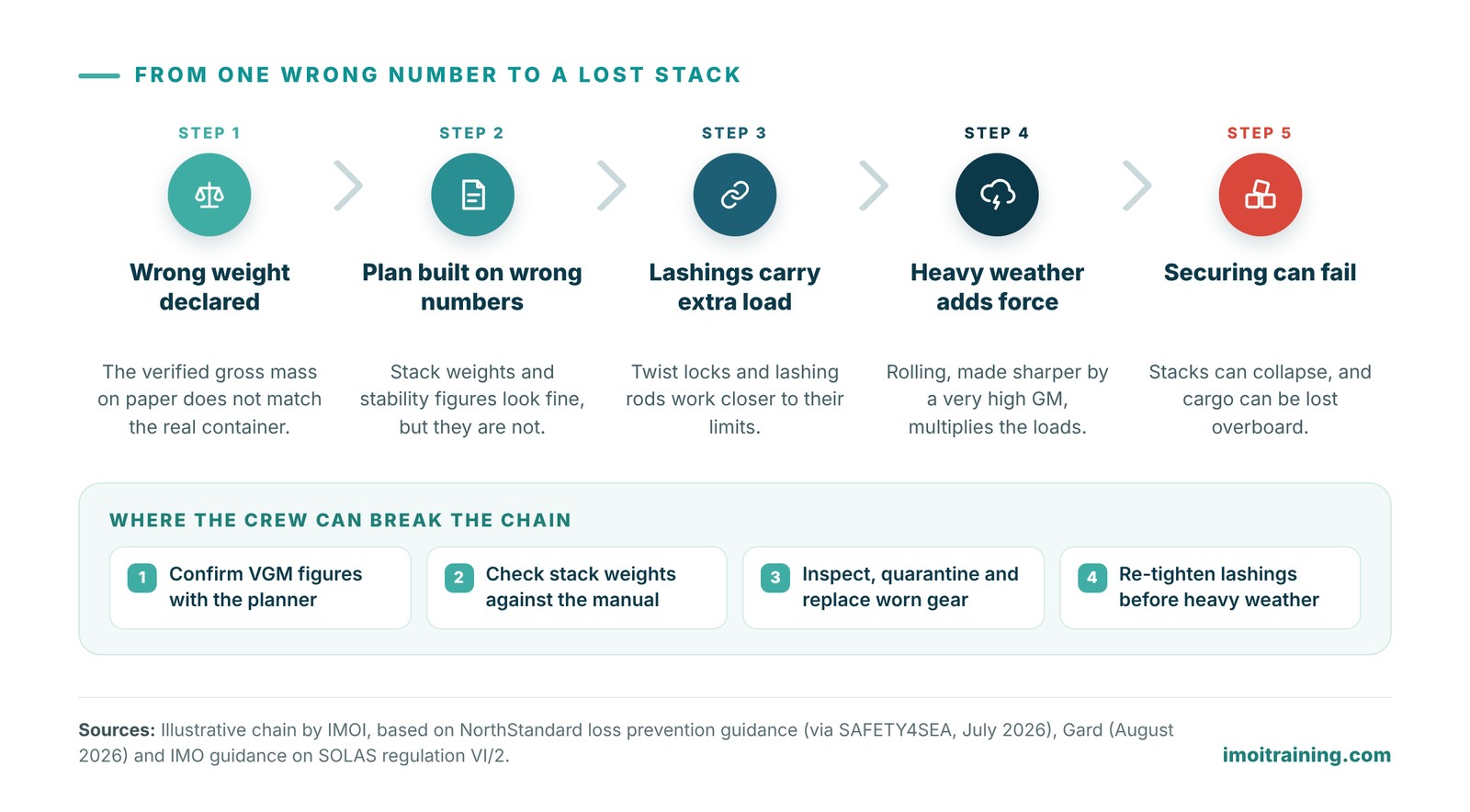
On container ships, NorthStandard lists these common contributing factors:
- Twist locks that are damaged or not properly engaged
- Lashing gear that is not approved, not documented or not compatible with the manual
- Worn or unserviceable lashing fittings and foundations
- Wrongly declared container weights, which can overstress lashings and lead to wrong stability calculations
- Stowage that does not match the manual
- A very high metacentric height (GM)
The GM point deserves a simple explanation. A ship with a very high GM is “stiff”. It snaps back quickly when it rolls, and that sharp motion puts heavy loads on the lashings.
On bulk carriers and general cargo ships, the risks look different. Weak lashing, too little dunnage or securing that ignores the CSS Code can let cargo shift. Project cargo carried on bulk carrier hatch covers brings its own risk: concentrated loads and extra lashing points can damage the covers.
Across all ship types, NorthStandard says failures are often traced back to poor planning, weak supervision or a poor understanding of the securing arrangements. Its investigations also find lashings removed too early, before the ship has entered port.
How can your ship prepare? A simple four-part check
You do not need a big project. You need four honest checks.
1. Check the manual
- Make sure the latest approved CSM is on board and is specific to your ship.
- Remove old or superseded copies.
- Confirm that the manual matches the equipment you actually carry.
- On container ships, lashing plans should clearly show the maximum stack weights, rather than relying only on the loading computer.
2. Check the gear
- Count portable securing devices against the manual, including brand and type.
- Remove damaged, corroded or non-compliant items and keep them in a marked quarantine area until disposal.
- Include cargo securing equipment in the planned maintenance system, with records that match the manual.
3. Check the plan
- Compare stack weights and their distribution with the limits in the manual.
- Confirm that VGM figures have been verified with the planner. For heavy-lift or project cargo, consider the exact vertical centre of gravity.
- Keep the loading computer and any lashing software up to date, with correct ship data.
- On long passages, lashings should be checked and tightened within 24 hours of departure, and again before and after heavy weather.
4. Check the people
- Brief officers and crew on the manual and the principles of the CSS Code.
- Make sure both senior and junior officers can use the loading computer.
- Run a short toolbox talk using the checks above. Ask each officer to explain the stack weight limits in their own words.
An officer who can explain the manual is the best evidence that it works.
What happens after 30 November?
The campaign ends on 30 November 2026. After that, the results will be analysed and presented to the governing bodies of both MoUs, with a view to a later submission to IMO.
The rules are moving too. In September 2026, IMO’s Sub-Committee on the Carriage of Cargoes and Containers (CCC 12) finalised revised guidelines for the Cargo Securing Manual, including a performance standard for lashing software. They still need approval by IMO’s Maritime Safety Committee.
Meanwhile, the checklist stays useful. Gard suggests using the questionnaire as a self-review tool.
Treat the CIC checklist as a free audit. Run it at your next port call, campaign or not.
Want your officers to face port State control with confidence? IMOI’s Port State Control (PSC) Inspection course explains how ships are selected and inspected, how deficiencies and detentions are handled, and how to prepare. For deck teams, our free self-paced Hatch Covers course and the Risk Assessment and Risk Management course build the practical side.
Frequently asked questions
What is a Concentrated Inspection Campaign (CIC)?
A CIC is a three-month campaign in which port State control officers focus on one subject during routine inspections, using a set questionnaire. The 2026 Paris MoU and Tokyo MOU campaign focuses on cargo securing.
When does the 2026 cargo securing campaign end?
It runs from 1 September to 30 November 2026. Each ship receives only one CIC inspection per MoU during this period.
Can a ship be detained during the campaign?
Yes. If the answer is “No” to a question marked with an asterisk, the ship may be considered for detention. That is seven questions on the Paris MoU form and nine on the Tokyo MOU form. Action can range from recording a deficiency to detaining the ship.
What is a Cargo Securing Manual?
It is a ship-specific manual, approved by the flag Administration, that explains how cargo units must be stowed and secured on that ship. SOLAS chapter VI, regulation 5, requires cargo units to be secured throughout the voyage in line with it.
Who provides the verified gross mass (VGM) of a container?
The shipper. Under SOLAS chapter VI, regulation 2, as amended from 1 July 2016, the VGM must be provided in time for the ship’s stowage plan. It is a condition for loading a packed container.

About the author: Capt. Srirang Manjeshwar
Capt. Srirang Manjeshwar is senior faculty and Training Director at IMOI. A former Master on Suezmax, Aframax and ULCC oil tankers, he has trained marine personnel since 1995 and has helped train more than 750 cadets since 2000. He retired as Director and Head of Training at Wallem Maritime Training.
Sources
- Paris MoU, “Paris and Tokyo MoUs launch 2026 Concentrated Inspection Campaign on Cargo Securing”, 3 August 2026. parismou.org
- Paris MoU and Tokyo MOU, Joint Press Release and Paris MoU Questionnaire, CIC on Cargo Securing 2026, 3 August 2026. parismou.org
- Tokyo MOU, Joint Press Release and Tokyo MOU Questionnaire, CIC on Cargo Securing 2026, 3 August 2026. tokyo-mou.org
- Black Sea MoU, Press Release, CIC on Cargo Securing, 7 August 2026. bsmou.org
- Australian Maritime Safety Authority (AMSA), “Prepare now: cargo securing inspection campaign”, 28 August 2026. amsa.gov.au
- International Maritime Organization (IMO), “Verification of the gross mass of a packed container” (SOLAS regulation VI/2). imo.org
- UK Maritime and Coastguard Agency, MGN 699 (M), Annex C: Stowage and securing, Cargo Securing Manual. gov.uk
- World Shipping Council, “Containers Lost at Sea Report: 2026 Update”, 25 June 2026. worldshipping.org
- Gard, “Cargo securing on the PSC agenda”, 14 August 2026. gard.no
- NorthStandard (via SAFETY4SEA), “Cargo securing in focus: Preparing for the 2026 PSC CIC”, 9 July 2026. safety4sea.com
- DNV, “IMO CCC 12” regulatory news, September 2026. dnv.com