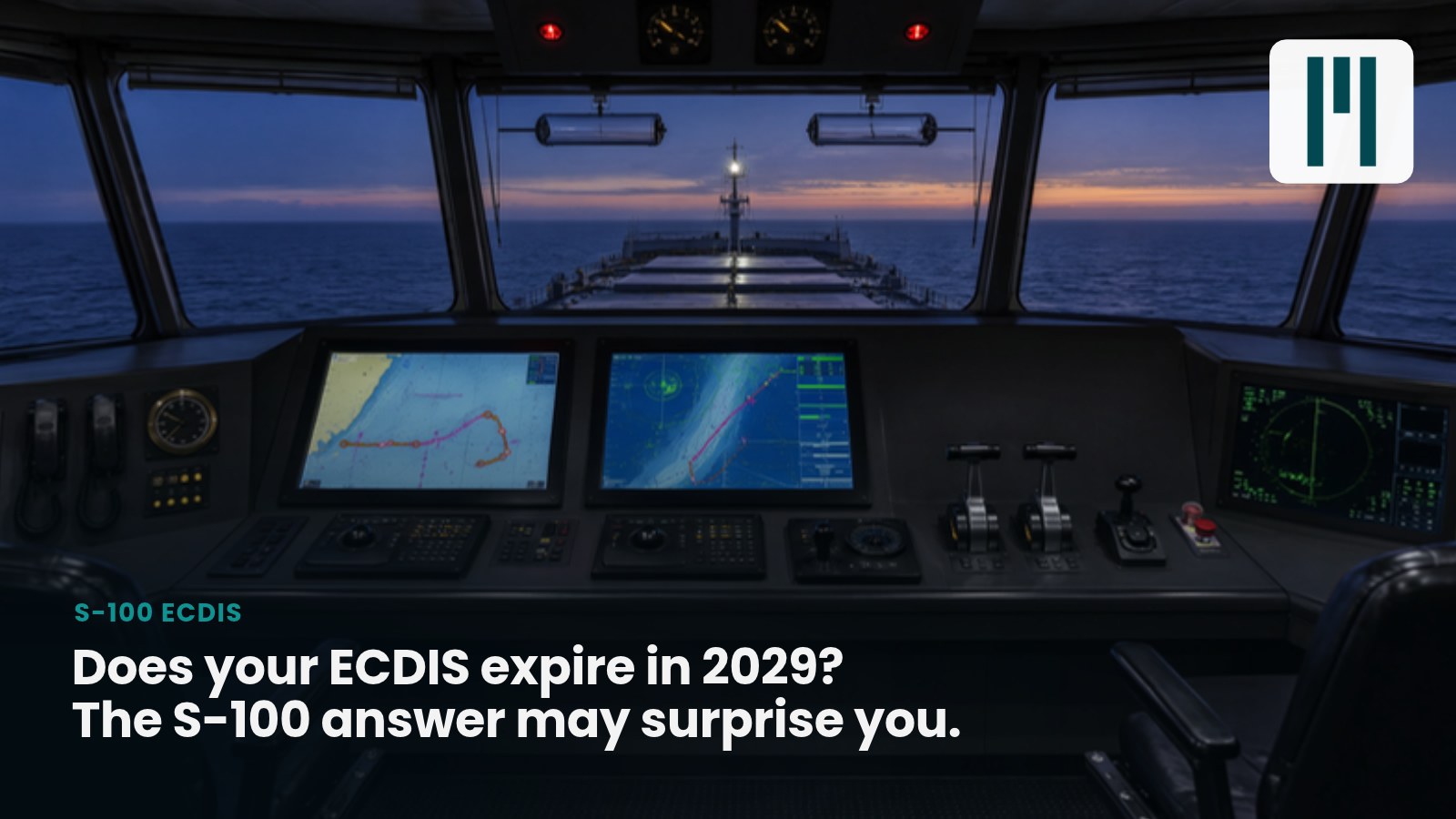
Here is a number that should make every navigator pause.
In more than 5,000 recent ECDIS assessments, about two-thirds of bridge teams could not identify ENC updates.
That is with today’s charts.
Now a bigger change is on its way. Since 1 January 2026, newly installed ECDIS may be built to a new standard that works with S-100 data. From 1 January 2029, every newly installed ECDIS must meet it.
So does every ship need a new ECDIS in 2029? Will today’s charts stop working? The short answers are no, and no.
This article explains S-100 ECDIS in simple words: what it is, the key dates, what you will see on screen, and what bridge teams should do now.
What is S-100, in simple words?
S-100 is a framework from the International Hydrographic Organization (IHO) for many kinds of digital marine data. Today’s electronic navigational charts (ENCs) use an older standard called S-57, which was built mainly for charts.
Think of S-57 as a paper chart turned digital. S-100 is closer to a map app on your phone, where you can switch extra layers on and off.
The IHO makes a similar comparison. In March 2026, Magnus Wallhagen, then Chair of the IHO’s Hydrographic Services and Standards Committee, said: “The implementation of S-100 for the maritime world is comparable to the early days of smartphones.”
Each type of data has its own product specification with an “S” number. The most important one for navigators is S-101, the new ENC that succeeds the S-57 ENC.
S-100 does not throw away the chart you know. S-101 keeps the familiar look and feel of S-57, with less clutter and greater clarity.
S-57 vs S-100: what really changes?
The biggest change is not the look of the chart. It is what can sit on top of it.
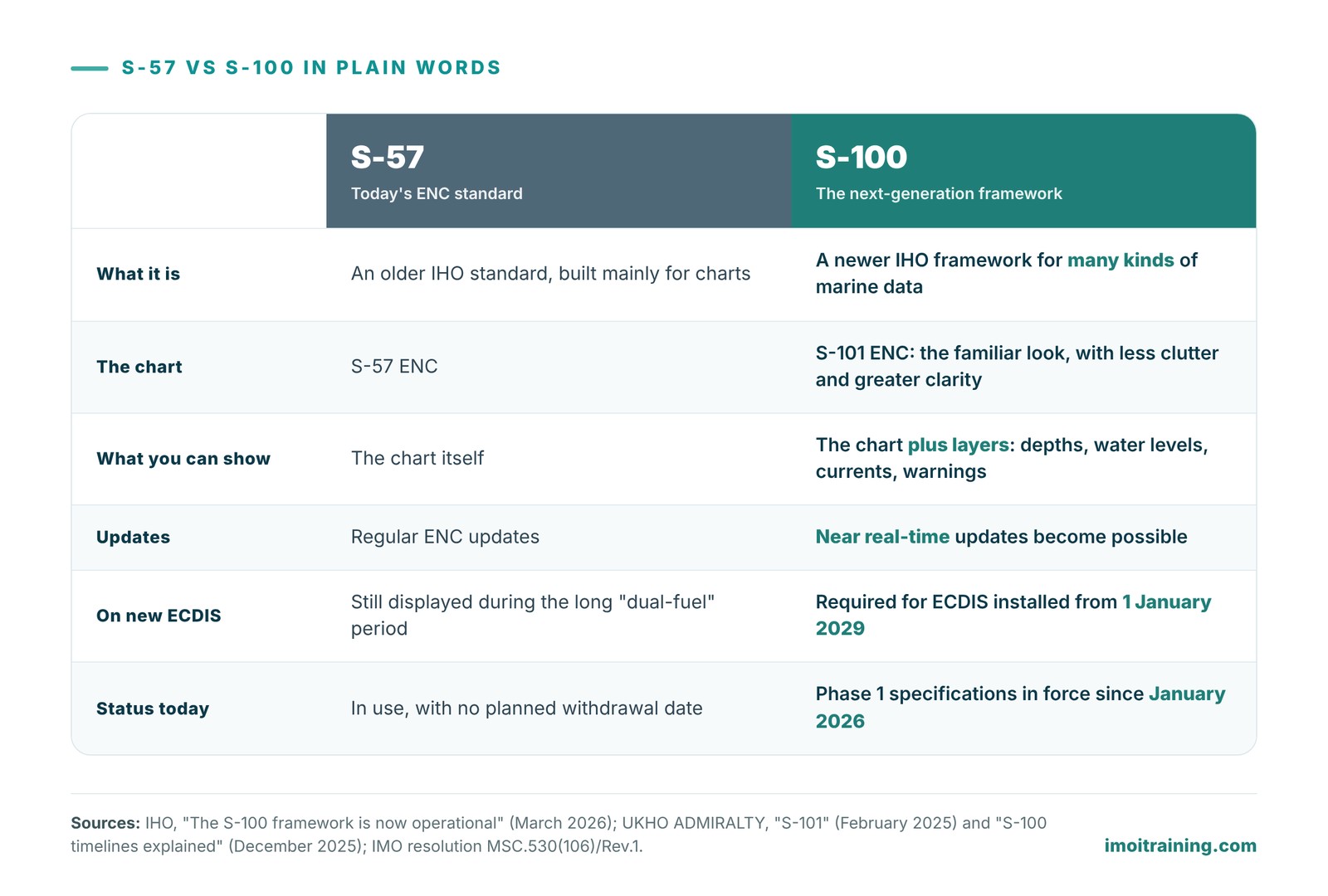
A few points stand out:
- More data, not just charts. S-100 can carry depths, water levels, currents and warnings as separate layers.
- Faster updates. According to the IHO, S-100 offers near real-time updates that S-57 does not.
- Standard route exchange. A 2024 revision of IMO’s ECDIS performance standards added a standard format, S-421, for exchanging route plans between ship and shore.
The chart stays familiar. The amount of information around it grows.
The key dates every officer should know
S-100 ECDIS rests on IMO’s revised performance standards for ECDIS, now resolution MSC.530(106)/Rev.1. Here is the timeline in plain words:
- November 2022: IMO adopts MSC.530(106), giving S-100 capable ECDIS an international basis.
- May 2024: IMO adopts a revised version, MSC.530(106)/Rev.1, which updates the 2022 text and standardises route plan exchange using S-421.
- January 2026: The IHO’s first set of S-100 product specifications, known as Phase 1, enters into force. ECDIS installed from 1 January 2026 may meet either the old or the new performance standard.
- Around 2028: The UK Hydrographic Office (UKHO) estimates that type-approved S-100 ECDIS will become commercially available.
- 1 January 2029: Any ECDIS installed on or after this date, including retrofits, must meet the new standard.
There is one honest caveat. In March 2026, the IHO noted that commercial S-100 ECDIS were not yet available. In June 2026, the UKHO still expected type-approved systems around 2028. Before then, it expects systems without type approval to appear first, for testing, familiarisation and back-of-bridge use.
Will your ship need a new ECDIS in 2029?
No. According to the UKHO, there is no requirement to replace existing ECDIS. The 2029 rule applies to ECDIS installed or retrofitted from that date onwards.
And will S-57 charts stop working? Also no. You may have heard that S-57 ends in 2029, but that is not what the hydrographic offices say.
S-57 and S-101 ENCs will be used side by side during a long “dual-fuel” period. Even after 2029, new ECDIS will still display S-57 ENCs. The UKHO says there is currently no planned date for withdrawing S-57 ENCs.
The 2029 date is about new equipment. It is not a switch-off date for today’s charts.
What will you actually see on an S-100 ECDIS?
You will see a familiar chart, with extra layers that you can turn on and off. The IHO’s Phase 1 products, in force since January 2026, are the first of these layers.
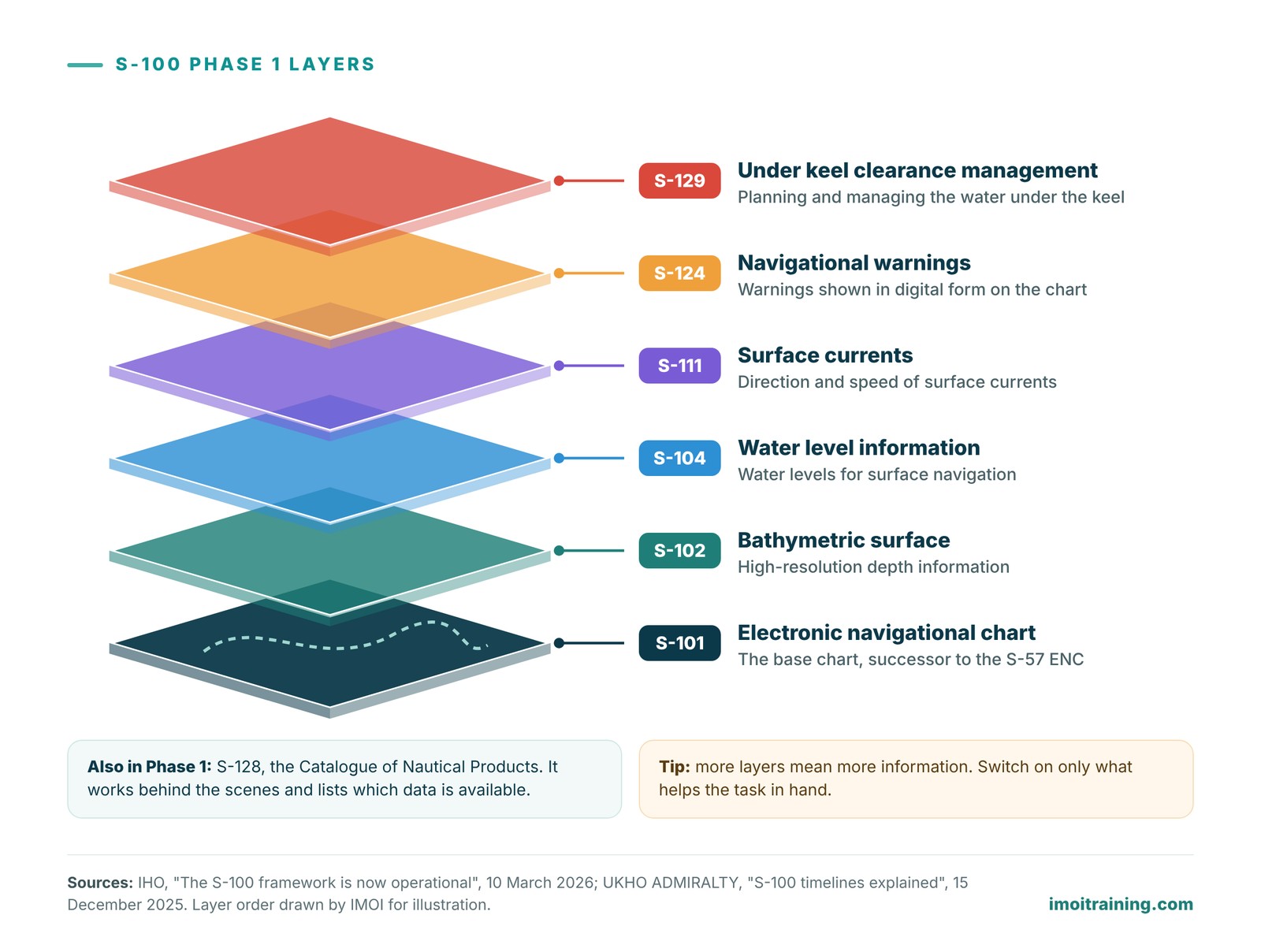
Here is what each one does:
- S-101 Electronic Navigational Charts: the base chart, and the successor to the S-57 ENC.
- S-102 Bathymetric Surface: high-resolution depth information.
- S-104 Water Level Information: water levels for surface navigation.
- S-111 Surface Currents: the direction and speed of surface currents.
- S-124 Navigational Warnings: navigational warnings in digital form.
- S-129 Under Keel Clearance Management: information for planning and managing under keel clearance.
- S-128 Catalogue of Nautical Products: a behind-the-scenes catalogue of the data that is available.
Picture a tight approach channel. Today, you combine a charted depth with a tide table and do the sums. Where S-100 data is available, depths, water levels and currents can sit on the same screen.
Later layers are also planned. They cover marine protected areas (S-122), radio services (S-123), aids to navigation (S-125), traffic management (S-127), harbour infrastructure (S-131), ice (S-411) and weather (S-412). Timelines for these are still being discussed.
More layers mean more information. They also mean more ways to miss the one that matters.
The real challenge: people, not boxes
New standards do not navigate ships. People do.
That is why the assessment numbers at the top of this article matter. NorthStandard’s ECDIS Training Assessment (ETA) is a test tool developed with the UKHO. A 2026 NorthStandard report studied more than 5,000 ETA assessments from almost 120 of its Members. It found that:
- About two-thirds of bridge teams could not identify ENC updates.
- Nearly half did not prioritise the correct ENC scale in planning.
- Many struggled to tell alarms from alerts, spot datum issues and verify positions.
- There were also gaps in safety settings (including contours), key symbols and ECDIS functions.
The UKHO, summing up the same report, lists other recurring problems: safety settings that did not always match charted depths, and alarm settings that were misunderstood or set up incorrectly.
The IHO itself admits that some users hesitate because of information overload. Its answer is simple: the benefits become clear once users learn which products are useful in each situation and how to toggle the layers.
S-100 will add information to the screen. It will not add judgement to the bridge team.
What should bridge teams do now?
You do not have to wait for 2029 to get ready. Start with what you already have.
For officers
- Master today’s basics. ENC updates, safety contour and safety depth, alarms and alerts, and chart scale all carry over into S-100.
- Learn the new names. S-101, S-102, S-104, S-111, S-124 and S-129 will soon be part of bridge vocabulary.
- Ask before you trust. If a new ECDIS is fitted, find out whether it is type-approved to the new standard or a system for familiarisation only.
For companies and training heads
- Plan installations around 2029. Any ECDIS installed or retrofitted from 1 January 2029 must meet the new standard.
- Budget for familiarisation. New layers and new menus will need hands-on practice, not just a manual.
- Use your data. Assessment results like the ETA findings show where your bridge teams need help first.
The best preparation for S-100 is a bridge team that truly understands its ECDIS today.
Want your bridge team ready for the next generation of ECDIS? IMOI’s 2-day ECDIS Refresher Program updates officers on ECDIS regulations, chart navigation, safety settings and voyage planning. New junior officers can build the basics in our Junior Officer Briefing Program (with ECDIS Familiarization), and our Bridge Team Resource Management (BTRM) course strengthens teamwork on the bridge.
Frequently asked questions
What is S-100 ECDIS?
It is an ECDIS that meets IMO’s revised performance standards, resolution MSC.530(106)/Rev.1, and can use IHO S-100 data such as S-101 ENCs. It will also continue to display S-57 ENCs.
Is S-100 ECDIS mandatory?
From 1 January 2029, any newly installed ECDIS, including retrofits, must meet the new standard. Existing ECDIS do not have to be replaced. Strictly, the IMO resolution recommends these dates, but SOLAS requires an ECDIS used for chart carriage to meet the IMO performance standard in force when it is installed.
Will S-57 ENCs stop working in 2029?
No. S-57 and S-101 ENCs will be used side by side. According to the UKHO, there is currently no planned date for withdrawing S-57 ENCs.
What is the difference between S-57 and S-101?
S-101 is the S-100 based successor to the S-57 ENC. It keeps the familiar look and feel of S-57, with less clutter and greater clarity. It also forms the base for other S-100 layers.
Can ships use S-100 data today?
The first S-100 product specifications entered into force in January 2026. Hydrographic offices can now produce and test S-100 data, and portable pilot units and port authorities can already use it. For ECDIS, the UKHO expects type-approved S-100 systems around 2028.

About the author: Capt. Srirang Manjeshwar
Capt. Srirang Manjeshwar is senior faculty and Training Director at IMOI. A former Master on Suezmax, Aframax and ULCC oil tankers, he has trained marine personnel since 1995 and has helped train more than 750 cadets since 2000. He retired as Director and Head of Training at Wallem Maritime Training.
Sources
- International Maritime Organization (IMO), Resolution MSC.530(106), Performance standards for electronic chart display and information systems (ECDIS), adopted 7 November 2022. wwwcdn.imo.org
- IMO, Resolution MSC.530(106)/Rev.1, Performance standards for ECDIS, adopted May 2024 (MSC 108). Summary: Hong Kong Marine Department, Merchant Shipping Information Note No. 46/2024, 2 December 2024. mardep.gov.hk
- UK Hydrographic Office (ADMIRALTY), “S-100 timelines explained”, 15 December 2025. admiralty.co.uk
- UK Hydrographic Office (ADMIRALTY), “S-101: The next generation of Electronic Navigational Charts (ENCs)”, 25 February 2025. admiralty.co.uk
- Tom Mellor, UK Hydrographic Office, “Op-Ed: How the Industry is Building S-100 Readiness”, The Maritime Executive, 29 June 2026. maritime-executive.com
- International Hydrographic Organization (IHO), “The S-100 framework is now operational”, 10 March 2026. iho.int
- UK Hydrographic Office (ADMIRALTY), “Why ECDIS training remains critical to safe navigation”, 27 April 2026. admiralty.co.uk
- NorthStandard, “ETA report offers first ever industry benchmark of ECDIS knowledge”, press release published by The Maritime Executive, 29 April 2026. maritime-executive.com